
How to Choose a UI/UX Design Agency in India
If you're searching for a UI/UX design agency in India, you're probably already comparing portfolios, reading case studies, and trying to figure out whether the quality you're seeing is repeatable or was a one-off effort for a big client.

What to Actually Evaluate
This guide won't tell you to "look for agencies with strong communication" or "review their past work." You already know that. This is about the specific things that separate agencies that produce good-looking work from agencies that produce work that performs.
Table of Content


The Market Reality First
India's design agency market in 2026 looks like this: a large number of studios that produce competent visual output, a smaller number that do genuine product design with research and strategy, and a very small number that have experience across funded startup contexts where design decisions have real business consequences.Most founder mistakes in hiring a design agency come from not knowing which category they're talking to. An agency that is excellent at brand identity may produce poor product UI. An agency that is excellent at large enterprise portals may not know how to move fast in a 0-to-1 startup context. Know what you need before you start evaluating anyone.
Step 1: Define What You Actually Need
- Before evaluating any agency, be specific about your brief. These are meaningfully different engagements.
- Brand and identity means logo, visual language, typography, colour system. The deliverable is a brand guide.
- Product UI design means screens, flows, components, design system. The deliverable is a Figma file ready for engineering handoff.
- UX strategy plus product design means research, user interviews, critical path mapping, then screens. The deliverable is a strategy document followed by a design system.
- Website design means a marketing site, not a product. Focused on conversion, messaging, and visual brand expression. A different skill set from product design.
- A revamp means you have an existing product that isn't converting or retaining. The deliverable starts with an audit, then redesign.
- Most agencies do some of these well and others adequately. Clarity on which you need will immediately narrow the shortlist.
Step 2: What to Look for in a Portfolio
- Portfolios are curated. Every agency shows its best work. What you're actually trying to assess is the thinking behind the work, not the visual output.
- Look for problem framing. Does the case study explain what was wrong with the previous state? "We redesigned the dashboard" is not problem framing. "Users were completing onboarding but abandoning at the first dashboard view because they couldn't find the core action" is.
- Look for before and after. Good design studios show the old state. If every case study starts with beautiful new screens and no comparison, they're hiding either the starting point or the rationale.
- Check client context. Is the work relevant to your context? An agency that has designed for fintech products will bring pattern recognition you can't replicate with a generic studio. If you're a fintech startup, look at their fintech work specifically.
- Read for outcome language. Not every outcome can be shared publicly. But good studios will at minimum describe what the design was trying to achieve, even without exact numbers. "The goal was to reduce drop-off at the payment confirmation step" is useful. "We designed a beautiful app for a payments company" is not.
Step 3: The Questions to Ask in the First Call
- The first call with an agency tells you a lot if you ask the right things. These are the questions that reveal process and thinking, not just whether they're friendly.
- "Walk me through a project that didn't go the way you expected." Every real agency has war stories. Agencies that claim every project was smooth are either lying or taking on only the safest briefs.
- "What would you want to learn before starting design work?" The answer should be: users, the business model, the constraints, what's already been tried. If the answer is "tell us about your brand and we'll get started," they're skipping research.
- "How do you handle disagreement with the client on a design decision?" Good agencies have a position and defend it with evidence. Bad agencies defer to whatever the client wants. You're paying for their judgment, not their compliance.
- "What does your handoff process look like?" This matters enormously if you have an engineering team. Ask specifically about developer-ready specs, what format they use, and whether they stay engaged during implementation.
- "What's been the most challenging brief you've taken on in the last year?" Listen for specificity. Real challenges sound specific. Generic answers about tight timelines suggest limited experience.
Step 4: The Red Flags
These are patterns that should make you pause, not necessarily disqualify, but each one warrants a direct conversation.
- No research in the process. If the process goes straight to visual design without user research or at least a discovery phase, you're buying aesthetic output, not UX. This is fine for a brand refresh. It's a problem for a product that needs to convert and retain users.
- One-size portfolio. If every project looks visually similar regardless of client, the studio is applying a house style rather than solving client-specific problems. Great design studios look different from project to project because different clients have different problems.
- No pricing transparency. Many agencies don't publish prices, which is standard since project scopes vary. But if they refuse to give you any pricing range before a full scoping call, that's an inefficiency for both parties. A good agency can give you a rough range based on your brief within 24 hours.
- Overselling celebrity clients. Working with a large client once doesn't make an agency expert in that category. Ask specifically what the scope of the engagement was. "We worked with Ola" can mean a week of brand collateral or a six-month product design sprint. They're not the same credential.
- Junior-heavy execution with senior-only pitch. This happens more often in mid-size agencies: senior designers present, junior designers execute, and the quality gap shows up after you've signed the contract. Ask directly who will be doing the work, not just who is on the pitch.
Step 5: What Good Looks Like
Rather than describing good abstractly, here's what strong UI/UX design output actually produces.
For Motilal Oswal, we redesigned parts of their digital investment experience. The goal was to reduce the cognitive load of financial decision-making, making charts, numbers, and actions clearer through hierarchy and progressive disclosure. The design brief was about trust and clarity for retail investors, not just visual modernisation.
For Simplilearn, the homepage revamp addressed a conversion problem: too much content, an unclear primary CTA, weak hierarchy. The revamp prioritised one action per scroll section and reduced the time to the CTA. Marketing site, not a product, but the same underlying principle: clarity drives action.
For RenewBuy, we worked on a product designed for insurance agents making purchasing decisions on behalf of customers in real time. The experience needed to be fast, decision-supportive, and error-free. The design system we built supported that specific context.What links these: in each case, the design decision was tied to a specific user behaviour in a specific context. The output wasn't screens. The output was a change in how the product worked for its users.
Step 6: India-Based vs. International Agencies
If you're a global startup considering India-based design partners, here's the practical comparison.

India-based makes sense for a significant cost advantage without quality trade-off at top-tier studios, strong English communication with minimal timezone friction for real-time collaboration, deep familiarity with both Indian market contexts and global product standards, and direct experience with the startup ecosystem challenges you're navigating.
What to check: has the studio worked with international clients or designed for global user bases? Are the case studies from companies you recognise at least in category? Is the communication style direct and responsive, or does it require extensive follow-up?
We're based in Bangalore. Our clients include Singtel in Singapore, Gamma AI in the US, and Wise globally, alongside Indian-market companies like Motilal Oswal, RenewBuy, and Simplilearn. The context shifts. The process doesn't.

How to Evaluate an Agency's Design Process
Most agencies describe their process in broad strokes: discovery, ideation, design,What matters is the detail underneath each phase. These are the specifics worth handoff.
Discovery:how deep do they actually go?
A surface-level discovery phase means one kickoff call, a brief document, and a mood board. A real discovery phase means structured stakeholder interviews with the founding team and key users, a competitive landscape review, and a clear articulation of the design problem before any solution work starts. Ask how many user interviews they typically run in discovery. If the answer is zero, they're not doing discovery. They're doing intake.
Ideation: do they show their thinking?
Good agencies show multiple directions before committing to one. Not because they're indecisive, but because exploring multiple approaches early is far cheaper than discovering the wrong approach late. If an agency goes from brief to final designs with out a diverge-then-converge step, they're optimising for speed at the cost of quality.
Design:how do they handle feedback?
Ask for an example of how they managed a feedback cycle on a recent project. Good agencies have a structured feedback process:feedback is collected in one round, consolidated, and responded to with clear reasoning what they are and aren't changing. Bad agencies implement every comment immediately and lose the design rationale in the process.
Handoff: what does the engineer receive?
A Figma file is not a handoff. A proper handoff includes annotated specs for interactive states, spacing, typography, and colour tokens; acomponent library with variants; and a walkthrough session with the engineering team. Ask what their handoff package looks like and whether they offer support during the build phase.
What a Realistic Design Engagement Timeline Looks Like
One of the most common misalignments between startups and design agencies is timeline expectations. Here is what realistic timelines look like for common engagement types.
A brand identity project covering logo, colour system, typography, and brand guidelines typically takes 6 to 8 weeks. This includes a discovery phase with brand positioning, 2 to 3 concept directions, refinement rounds, and final asset delivery. Agencies that promise this in 2 weeks are cutting the discovery and rationale stages.
A O-to-1 product design engagement covering UX strategy, wireframes, design system, and high-fidelity screens for an MVP typically takes 10 to 14 weeks. This is the minimum time to do it properly. Less than 10 weeks usually means wireframes and high-fidelity are being compressed into a single phase, which reduces the quality of both.
A website revamp for a marketing site covering homepage, service pages, and core templates typically takes 6 to 10 weeks depending on the number of pages and the complexity of the content hierarchy. This includes copy direction in most good engagements, because the visual design and the copy structure are inseparable on a conversion-focused site.
A product revamp for an existing product with a real user base typically takes 8 to 16 weeks depending on scope. This should always start with a UX audit phase that identifies the specific problems being solved. Revamps that skip the audit phase often redesign the wrong things beautifully.
The Right Way to Start a New Design Engagement
The right way to start with a new design partner is not a 12-month contract. It's a defined first engagement with a clear deliverable.
- For product design: a UX audit and strategy brief over 4 to 6 weeks before any screens are designed. This gives both parties a real sense of how we work together, and it produces something useful regardless of whether the engagement continues.
- For website or brand work: a single project like a homepage or brand identity with a defined scope. Evaluate the output and the process together.
If an agency pushes hard for a long retainer before you've seen how they work, be cautious. Confidence in output is demonstrated by taking on a defined first scope and delivering it well.
Latest Articles
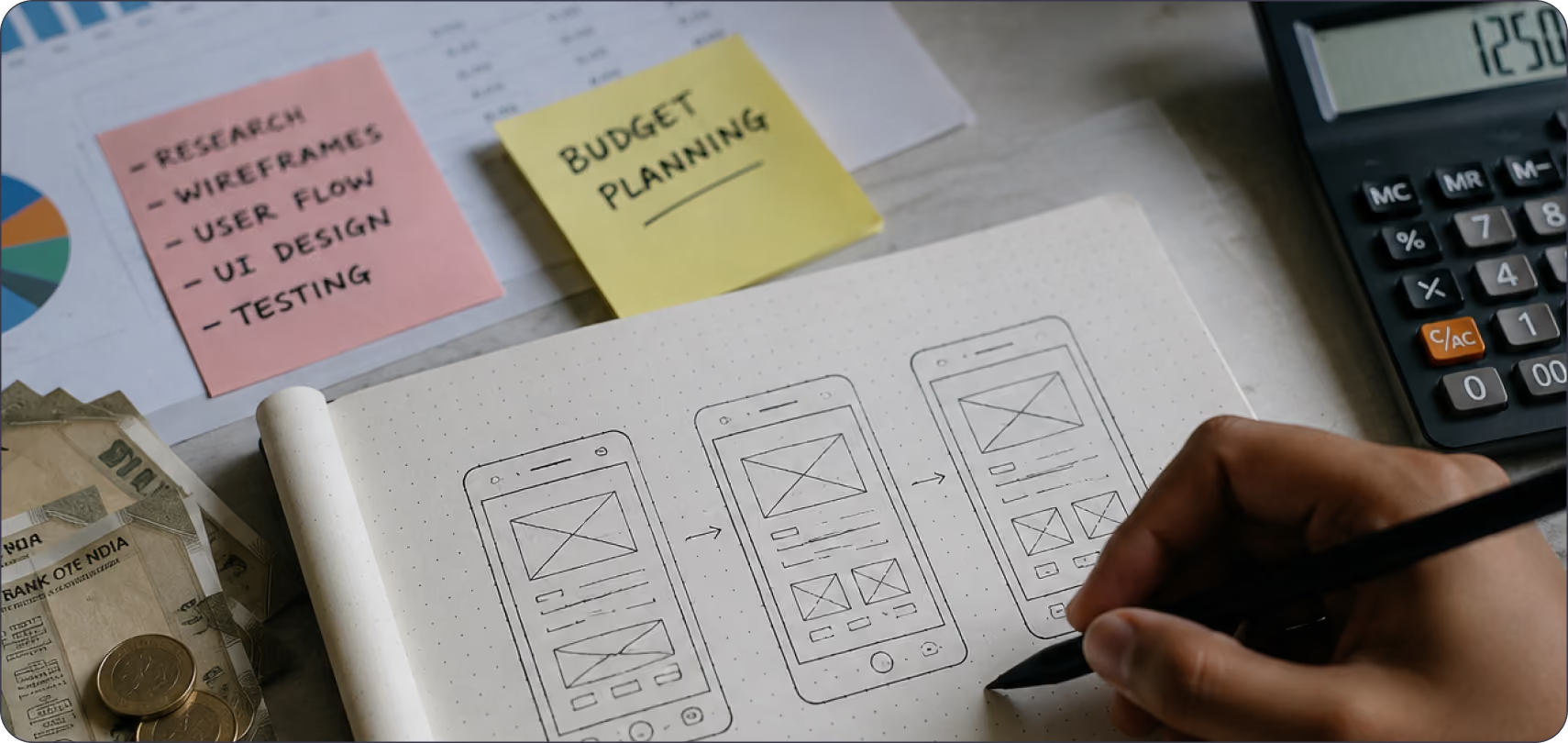
How Much Does UI/UX Design Cost in India?
Understand the key factors that influence UI/UX design pricing in India, from project scope and complexity to designer expertise and business requirements.
Latest Articles
What Does "Funded Startup" Mean When You Pick a Design Agency in India?
"Funded startup" means two different things in India right now, and most agency content mixes them up. One meaning comes from the government. The other comes from VCs and marketing copy.
Latest Articles
What Should Fintech Founders Look For in a UI/UX Design Agency in 2026?
Two terms cause most of the confusion when fintech founders search for design help this year. "Dark pattern" has two separate legal definitions active in India right now, and "UX agency" covers three completely different service models under one label.
Latest Articles
Mobile UX Trends in 2026: What's Actually Changing and What's Just Noise
Every year, the same list circulates: dark mode, gestures, micro-animations, personalisation. Most of it is either already standard or too surface-level to act on.
Latest Articles
What UX Features Do Users Expect From Apps in 2026?
Explore the emerging UX features transforming mobile and web applications, helping businesses create faster, smarter, and more engaging digital experiences.
Latest Articles
How Can Startups Optimise Their UX Strategy
Dive into the world of UX Strategy tailored for startups in Bangalore. Find out how great UX impacts brands and drives growth in Startup India and USA.
Latest Articles
Design Systems 101: Building UI That Truly Scales
Discover how to create effective design systems for Figma. Enhance your UX with reusable components and streamline your workflow using Figma components.
Latest Articles
How to Design for AI - 101: Essential Tips and Tricks
Discover essential tips in our guide on How to Design for AI - 101. Learn the fundamentals and best practices for creating effective AI-driven designs.
Latest Articles
Design Trends 2026 Modern Ideas for Brands
Explore design trends 2026 shaping modern brands. Learn about AI, minimal design, bold typography, motion design, and sustainable strategies.
Latest ArticlesAbout Author:


Why choose Pen on Paper for future-ready design?

Got a question?
Get your answer

Ready to build AI-powered digital experiences?
Lorem ipsum dolor sit amet, consectetur adipiscing elit. Nunc vulputate libero et velit interdum.