

What Should Fintech Founders Look For in a UI/UX Design Agency in 2026?
Two terms cause most of the confusion when fintech founders search for design help this year. "Dark pattern" has two separate legal definitions active in India right now, and "UX agency" covers three completely different service models under one label.

The confusion around what a UI/UX agency actually means.
The Central Consumer Protection Authority defined dark patterns broadly in 2023. Its guidelines cover any UI or UX interaction designed to mislead users or subvert their decision-making, across every sector. RBI's definition is narrower and newer. Its Responsible Business Conduct Amendment Directions, 2026 name 11 specific dark pattern types for banks and NBFCs, with default-yes consent boxes, forced pop-up redirects, pre-selected add-ons, and manipulative decline-button text among them. This version comes with a hard compliance deadline, something the 2023 rules never had. "UX agency" is just as inconsistent. Eleken and UX Studio mean an embedded subscription designer. UXDA and Momentum mean a full research and strategy consultancy. TCS Design Studio and Qubika mean design bundled with engineering delivery. If you're comparing three agencies from three different pages, you may be comparing three different things.
Table of Content


What Counts as a Dark Pattern Under India's New Rules?
A dark pattern under RBI's 2026 directions is one of 11 named practices that mislead a banking customer, not a general design complaint. This list is far more specific than the horizontal 2023 CCPA guidelines most agencies still cite.
How Is CCPA's 2023 Definition Different From RBI's 2026 Rules?
The CCPA's Guidelines for Prevention and Regulation of Dark Patterns, 2023 apply across every sector, from e-commerce to travel booking. They describe dark patterns in general terms, as practices that subvert a user's autonomy or decision-making.
RBI's rules apply only to regulated financial entities, and they name concrete categories instead of general principles. This distinction matters because content written against the 2023 rules alone will miss requirements specific to banking and lending products.
What Are the 11 Dark Pattern Types RBI Names?
RBI's directions list specific patterns including default-yes consent boxes, forced pop-up redirects, pre-selected add-on products, and manipulative decline-button text, among others. Verify the complete list at RBI's official site (rbi.org.in), since the final directions run longer than any single summary can capture.
An agency building a lending or investment app in 2026 needs to check its flows against this named list. A general "avoid manipulative design" brief isn't enough anymore.
What Do RBI's 2026 Rules Actually Require From Banks and NBFCs?
RBI's finalized rules require every regulated entity to have a board-approved sales and advertising policy in place by December 31, 2026. The rules were finalized on June 15, 2026, per RBI Press Release No. 2026-2027/460, with an effective date of January 1, 2027.
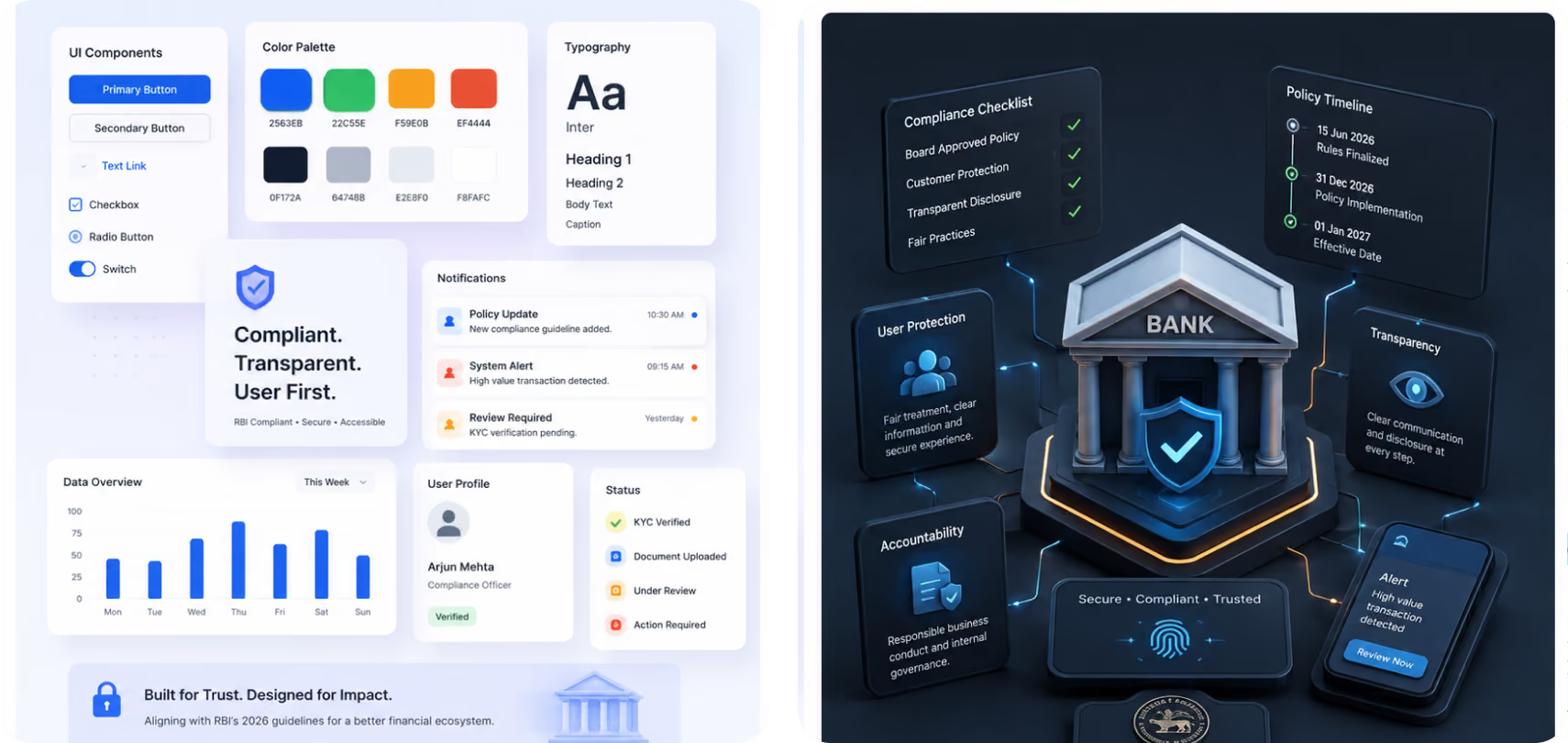
This is a change from the draft version. The original February 2026 draft mentioned a July 1, 2026 deadline, and some content online still cites that outdated date.
The rules also formalize mis-selling into five specific limbs. Liability for mis-selling now extends to unsuitable sales even when the customer gave consent, based on reporting from CorpLawUpdates.in dated four weeks before this research.A 2026 LocalCircles survey backs the case for these rules. Surveying 141,000 respondents across 386 districts, it found that 63% of banking users faced drip pricing, 61% experienced basket sneaking, 68% were trapped in difficult subscription cancellation flows, and 82% hit interface interference nudging them toward products they didn't want.
[SORA: a labeled timeline graphic showing three dates in sequence, February 2026 draft rules, June 15 2026 final rules, January 1 2027 effective date, flat icons, light background, 1200x630px]

What Do Fintech UX Agencies Actually Cost in 2026?
Fintech UX agencies in 2026 fall into two pricing tiers, subscription-based embedded designers and full compliance-fluent studios. Eleken's subscription model runs around $6,000 per month per designer, based on Excited.agency's June 2026 coverage.
Full fintech-specialist studios cost more because they carry compliance fluency into the process. Names in this tier include UXDA, Onething Design, and Topflight Apps.
Fuselab Creative's April 2026 pricing breakdown gives a wider range. US-based banking UX agencies run $50,000 to $200,000 per project. Offshore firms with a solid reputation run $15,000 to $60,000. Subscription models start at $5,000 to $6,000 per month.
A founder choosing between these tiers should ask one direct question before comparing rates. Does this agency understand RBI's specific rules, or only general UX best practices?
What Do the Top Search Results Miss About Choosing a Fintech UX Agency?
The top search results miss the connection between agency selection and RBI's 2026 compliance deadline entirely. Not one page ranking for this query combines "how to pick a fintech UX agency" with the January 2027 effective date.
Where Do the Ranked Listicles Fall Short?
Saasfactor's "Top 20 Fintech Design Agencies in 2026" runs long, likely past 3,000 words, but it stays heavy on agency rankings and thin on founder decision criteria.
Its main advice is to ask agencies about KYC and GDPR fluency, without mentioning India's own rules at all.Feelpixel's blog, updated roughly a month before this research, is India-specific but never mentions the 2026 RBI dark pattern rules. For a piece published this close to the final directions, that's a live gap.
Where Do the Global Guides Fall Short?
Excited.agency segments agencies by company stage with a "best for" format, and its pricing detail is genuinely useful. But it says nothing about Indian regulatory context, whether RBI or the DPDP Act.Fuselab Creative's guide is strong on pricing bands and gives founders pointed questions to ask agencies.
It's written from a US vendor's own competitive angle though, and it skips India-specific rules entirely.Onething Design's agency comparison reads more like a company profile than selection guidance. Superside's guide gives general advice to check for KYC and compliance case studies, but not tied to any one country's rules.
Is Any Existing Content Actually Tied to RBI's Rules?
One Medium piece from Design Studio UI/UX, dated May 11, 2026, is the only page found that ties agency-relevant UX practice directly to RBI's dark pattern rules. It's written as product design guidance though, not as agency-selection advice, so founders comparing agencies won't find it useful as a vetting checklist.
Which Sources Should Founders Actually Trust?
Founders should trust RBI directly for anything related to compliance deadlines and named dark pattern types. The Responsible Business Conduct Amendment Directions, 2026 is the primary source, and secondary summaries risk citing the outdated draft version.
For consent architecture questions that overlap with dark patterns, check the Digital Personal Data Protection Act, 2023 alongside RBI's rules, since the two overlap on consent requirements. For agency reputation and reviews, Clutch and DesignRush remain the two most-cited platforms across nearly every result for this query, though neither filters for regulatory fluency specifically.
What Changed Most Recently That Founders Should Know?
RBI finalized its dark pattern rules on June 15, 2026, moving the effective date to January 1, 2027 and replacing the earlier July 1, 2026 draft deadline. Most existing fintech UX content online hasn't caught up to this change yet.
The finalized rules also introduced something the draft didn't have. Mis-selling liability now applies even when a customer gave consent, if the sale itself was unsuitable for that customer. Any agency still designing consent flows around the old draft rules is working from outdated guidance
How Should a Fintech Founder Choose a Design Agency in India?
Start by asking any agency you're evaluating how they handle RBI's named dark pattern types, not just general UX best practices. If they can't name specific patterns like default-yes consent boxes or pre-selected add-ons, they haven't read the actual directions.
Ask for user research experience specifically in regulated finance, not just general product research. Compliance-aware research catches consent and disclosure issues before they reach a design review, which saves a rebuild later.Look at past UI/UX design work in fintech verticals specifically, not general SaaS work relabeled as fintech-ready.
Our work with Motilal Oswal involved building for a regulated financial product, where consent flows and disclosure design carry real compliance weight, not just conversion goals.
Latest Articles

How Much Does UI/UX Design Cost in India?
Understand the key factors that influence UI/UX design pricing in India, from project scope and complexity to designer expertise and business requirements.
Latest Articles
What Does "Funded Startup" Mean When You Pick a Design Agency in India?
"Funded startup" means two different things in India right now, and most agency content mixes them up. One meaning comes from the government. The other comes from VCs and marketing copy.
Latest Articles
Mobile UX Trends in 2026: What's Actually Changing and What's Just Noise
Every year, the same list circulates: dark mode, gestures, micro-animations, personalisation. Most of it is either already standard or too surface-level to act on.
Latest Articles
What UX Features Do Users Expect From Apps in 2026?
Explore the emerging UX features transforming mobile and web applications, helping businesses create faster, smarter, and more engaging digital experiences.
Latest Articles
How Can Startups Optimise Their UX Strategy
Dive into the world of UX Strategy tailored for startups in Bangalore. Find out how great UX impacts brands and drives growth in Startup India and USA.
Latest Articles
How to Choose a UI/UX Design Agency in India
If you're searching for a UI/UX design agency in India, you're probably already comparing portfolios, reading case studies, and trying to figure out whether the quality you're seeing is repeatable or was a one-off effort for a big client.
Latest Articles
Design Systems 101: Building UI That Truly Scales
Discover how to create effective design systems for Figma. Enhance your UX with reusable components and streamline your workflow using Figma components.
Latest Articles
How to Design for AI - 101: Essential Tips and Tricks
Discover essential tips in our guide on How to Design for AI - 101. Learn the fundamentals and best practices for creating effective AI-driven designs.
Latest Articles
Design Trends 2026 Modern Ideas for Brands
Explore design trends 2026 shaping modern brands. Learn about AI, minimal design, bold typography, motion design, and sustainable strategies.
Latest ArticlesAbout Author:


Why choose Pen on Paper for future-ready design?


Got a question?
Get your answer

Ready to build AI-powered digital experiences?
Lorem ipsum dolor sit amet, consectetur adipiscing elit. Nunc vulputate libero et velit interdum.