
How Much Does UI/UX Design Cost in India?
Understand the key factors that influence UI/UX design pricing in India, from project scope and complexity to designer expertise and business requirements.

What does UI/UX design actually cost in India right now?
UI/UX design in India costs anywhere from a few thousand rupees an hour for a freelancer to several lakh rupees for a full enterprise design system, and the range depends heavily on who you hire and what you need. Freelancer rates typically run 1,500 to 4,000 rupees an hour, according to Zethic's May 2026 pricing guide. Agency rates run higher, from around 2,500 to 8,000 rupees an hour depending on seniority, per Aufait UX's March 2026 breakdown.
Project-based pricing tells a clearer story for most founders. An MVP app design typically costs 60,000 to 3,00,000 rupees. A SaaS dashboard runs 1,50,000 to 6,00,000 rupees. A fintech app with real compliance complexity runs 3,00,000 to 15,00,000 rupees, according to DigiFlute's cost breakdown, published within the last week as of this writing. Enterprise-scale design system projects can reach 35 lakh to over a crore, per Aufait UX.
Table of Content

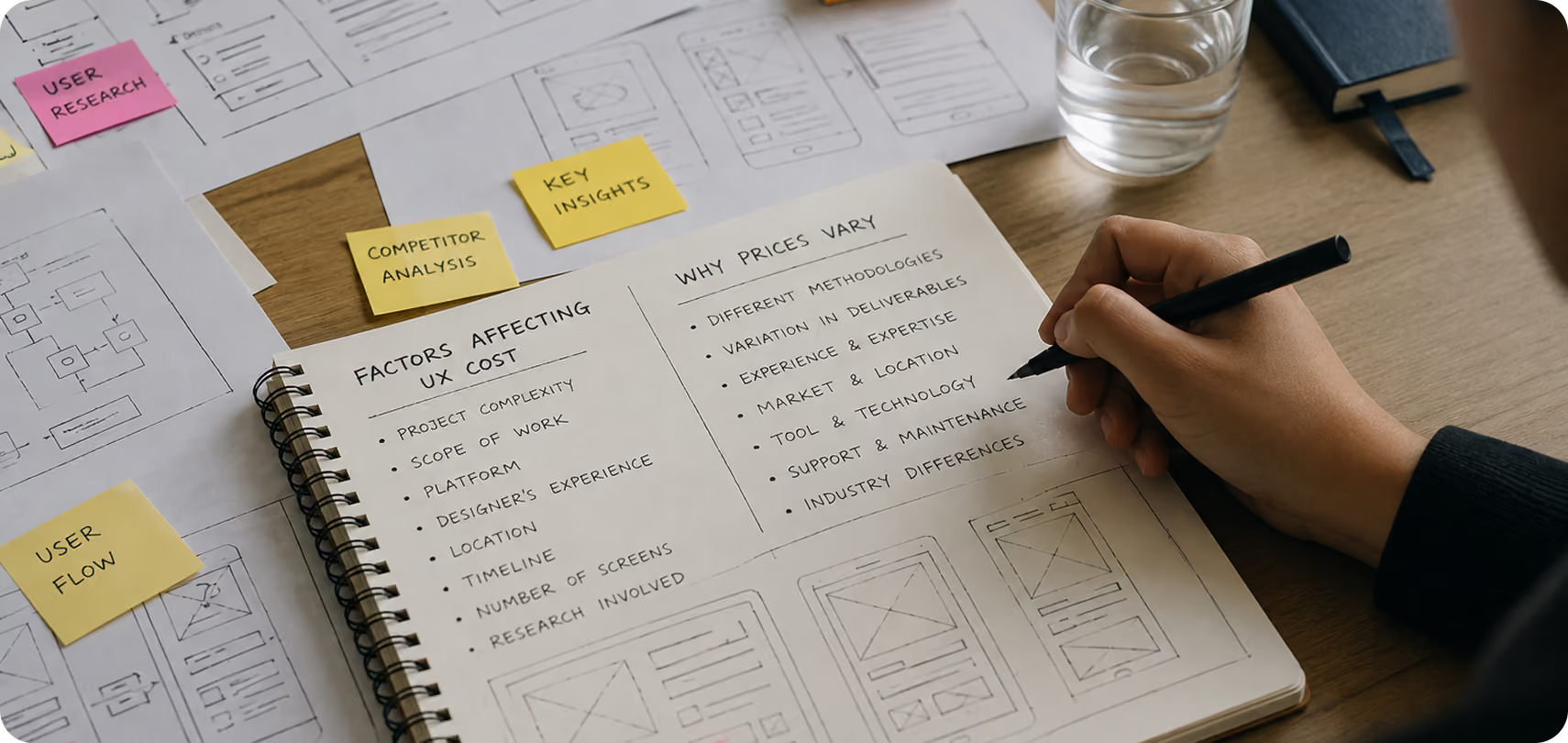
Why does the price range vary so much between sources?
Because "UI/UX design" isn't one product. A single landing page and a twelve-screen fintech onboarding flow both fall under the same search term, but they cost completely different amounts to design properly.The pricing model also changes the number.
A freelancer charging by the hour on a small scope will look cheap next to an agency quoting a fixed project price, even if the agency's total hours end up lower because of a more experienced team. Comparing an hourly rate to a project quote directly is comparing two different things.
Publish dates matter too. EmergeDigital's cost guide, from September 2024, and DesignMonks' guide, from September 2025, are both close to or over a year old relative to mid-2026. Design pricing moves quickly enough that a guide from 2024 is likely understating current agency rates.
What is the actual difference between UI pricing and UX pricing?
UI design, the visual and interaction layer, tends to be priced as execution work: screens, components, and visual polish. UX design, the research and behavior layer, tends to be priced as strategy work: user interviews, flow mapping, and testing.Zethic's 2026 breakdown separates these two cost drivers explicitly, and it's a useful distinction most other sources skip by bundling "UI/UX" into one line item. UX work usually costs more per hour than UI work, because it requires more senior judgment and takes longer to validate.
A founder budgeting for "UI/UX design" without separating the two risks underestimating the UX research portion, which is often the part that actually determines whether the product works.
What are the different pricing models, and how do they change the number you see?
What is fixed-price pricing, and when does it make sense?
Fixed-price pricing sets one number for a defined scope, like a ten-screen MVP. It works well when requirements are clear and unlikely to change mid-project, since any scope change usually means a separate negotiation.
What is hourly or time-and-materials pricing, and when does it make sense?
Hourly, or time-and-materials, pricing bills for actual hours worked. It fits an open-ended engagement where scope isn't fully known yet, but it requires more trust, since the final cost isn't fixed upfront.
What is a monthly retainer, and when does it make sense?
A retainer reserves a set amount of design capacity every month, often used by startups that need ongoing design support rather than one finished deliverable. It suits a product still evolving quickly, where new screens and iterations show up every sprint.
What is value-based pricing, and how does it differ from the other three?
Value-based pricing ties cost to the expected business outcome rather than to hours or a fixed scope, and it shows up more often in senior strategy engagements than in execution-heavy projects. Aufait UX names this as a distinct fourth model, separate from the other three, and it's the least common of the four for early-stage startup work specifically.
How does per-screen pricing work, and can you compare it across agencies?
Some agencies quote per screen rather than per hour or per project, with figures like 3,500 to 15,000 rupees a screen showing up in DigiFlute's fintech-specific breakdown. This unit is useful for scoping a known set of screens quickly, since a founder can estimate total cost by counting screens in a planned flow.
It doesn't compare cleanly across every source, though, since not every agency quotes per screen. Some only quote monthly retainers or full-project fixed prices, and converting between the two requires assumptions about how many hours went into each screen, which isn't always transparent.
Is UI/UX design getting cheaper because of AI tools?
Partially, and only on the execution side. CreateXP's May 2026 guide notes that AI-assisted design tooling is starting to compress the cost of wireframing and visual production, the more mechanical parts of the process, while strategic and behavioral design work is holding steady or increasing in price.
This means a founder shouldn't expect overall UI/UX costs to drop across the board. The parts of the process that require judgment, research, and testing are not the parts AI tooling replaces yet, and those are usually the parts that determine whether a product actually works for its users.
What is the actual difference between UI pricing and UX pricing?
UI design, the visual and interaction layer, tends to be priced as execution work: screens, components, and visual polish. UX design, the research and behavior layer, tends to be priced as strategy work: user interviews, flow mapping, and testing.

Zethic's 2026 breakdown separates these two cost drivers explicitly, and it's a useful distinction most other sources skip by bundling "UI/UX" into one line item. UX work usually costs more per hour than UI work, because it requires more senior judgment and takes longer to validate. A founder budgeting for "UI/UX design" without separating the two risks underestimating the UX research portion, which is often the part that actually determines whether the product works.
How should a founder budget for UI/UX design without overpaying or underscoping?
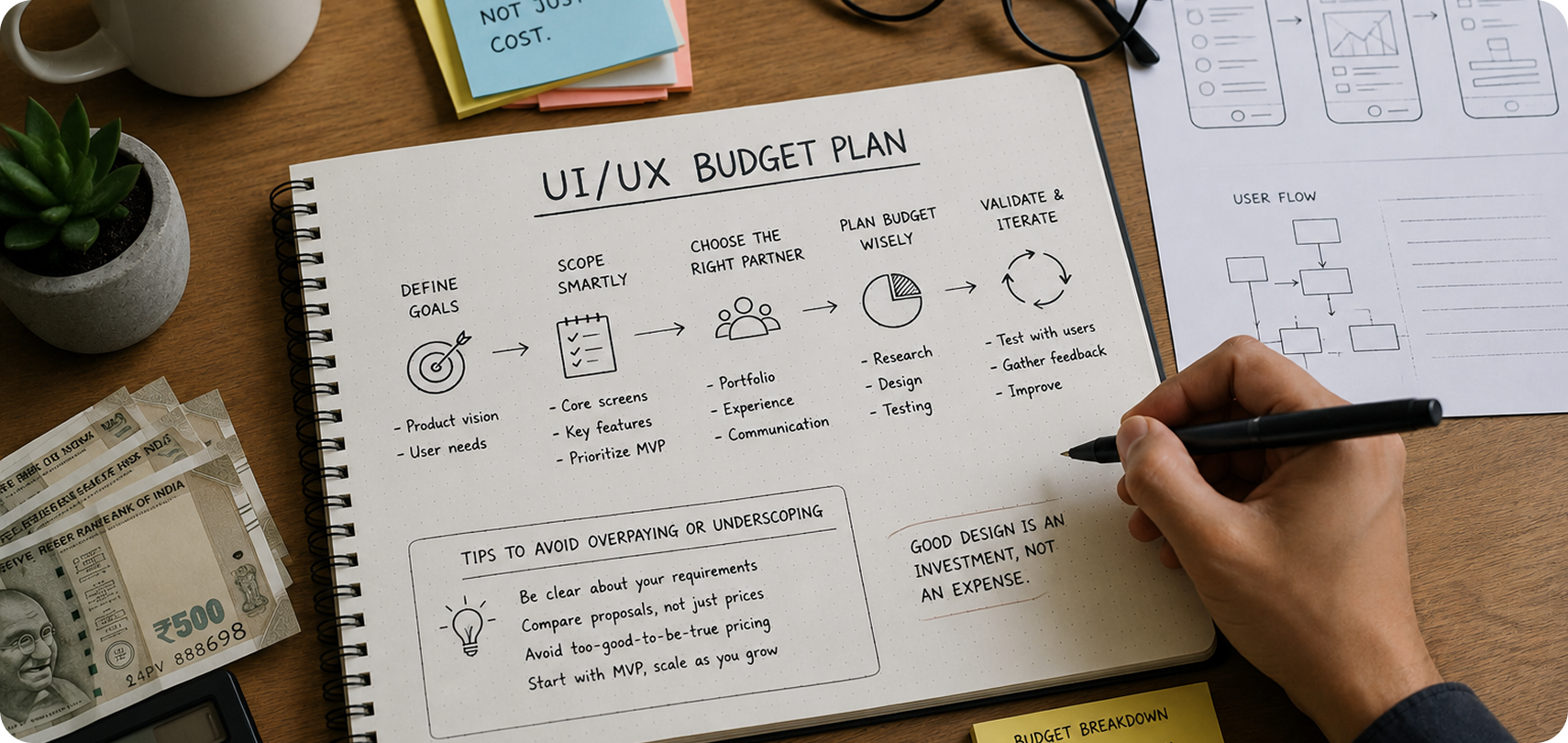
Start by defining what kind of project this is: a small fixed scope, an evolving product needing ongoing support, or a strategic engagement where outcomes matter more than screen count. That answer points you toward one of the four pricing models before you request a single quote.Ask every agency to break out UI and UX costs separately, not bundled into one number, so you can see how much of the budget goes to research and validation versus visual execution. If a quote has no research or testing line item at all, ask directly what happens if the first design
doesn't work for users, since the answer tells you whether the agency plans for iteration or just delivery.For a regulated product like fintech, budget above general MVP pricing from the start. DigiFlute's 2026 figures put fintech-specific work at 3,00,000 to 15,00,000 rupees, well above general app pricing, because of the added KYC, consent, and compliance-review layers that don't exist in a typical consumer product.
Pen On Paper works across all four pricing models depending on project type and stage, from fixed-scope MVP design to ongoing retainers for growing product teams. The clearest way to get an accurate number for your specific project is a short scoping call, bookable directly through Calendly or over WhatsApp, rather than comparing generic published ranges against your unique scope.
Latest Articles

What Does "Funded Startup" Mean When You Pick a Design Agency in India?
"Funded startup" means two different things in India right now, and most agency content mixes them up. One meaning comes from the government. The other comes from VCs and marketing copy.
Latest Articles
What Should Fintech Founders Look For in a UI/UX Design Agency in 2026?
Two terms cause most of the confusion when fintech founders search for design help this year. "Dark pattern" has two separate legal definitions active in India right now, and "UX agency" covers three completely different service models under one label.
Latest Articles
Mobile UX Trends in 2026: What's Actually Changing and What's Just Noise
Every year, the same list circulates: dark mode, gestures, micro-animations, personalisation. Most of it is either already standard or too surface-level to act on.
Latest Articles
What UX Features Do Users Expect From Apps in 2026?
Explore the emerging UX features transforming mobile and web applications, helping businesses create faster, smarter, and more engaging digital experiences.
Latest Articles
How Can Startups Optimise Their UX Strategy
Dive into the world of UX Strategy tailored for startups in Bangalore. Find out how great UX impacts brands and drives growth in Startup India and USA.
Latest Articles
How to Choose a UI/UX Design Agency in India
If you're searching for a UI/UX design agency in India, you're probably already comparing portfolios, reading case studies, and trying to figure out whether the quality you're seeing is repeatable or was a one-off effort for a big client.
Latest Articles
Design Systems 101: Building UI That Truly Scales
Discover how to create effective design systems for Figma. Enhance your UX with reusable components and streamline your workflow using Figma components.
Latest Articles
How to Design for AI - 101: Essential Tips and Tricks
Discover essential tips in our guide on How to Design for AI - 101. Learn the fundamentals and best practices for creating effective AI-driven designs.
Latest Articles
Design Trends 2026 Modern Ideas for Brands
Explore design trends 2026 shaping modern brands. Learn about AI, minimal design, bold typography, motion design, and sustainable strategies.
Latest ArticlesAbout Author:


Why choose Pen on Paper for future-ready design?



Got a question?
Get your answer

Ready to build AI-powered digital experiences?
Lorem ipsum dolor sit amet, consectetur adipiscing elit. Nunc vulputate libero et velit interdum.